
Exceptional Circumstances Route (Arraigo)
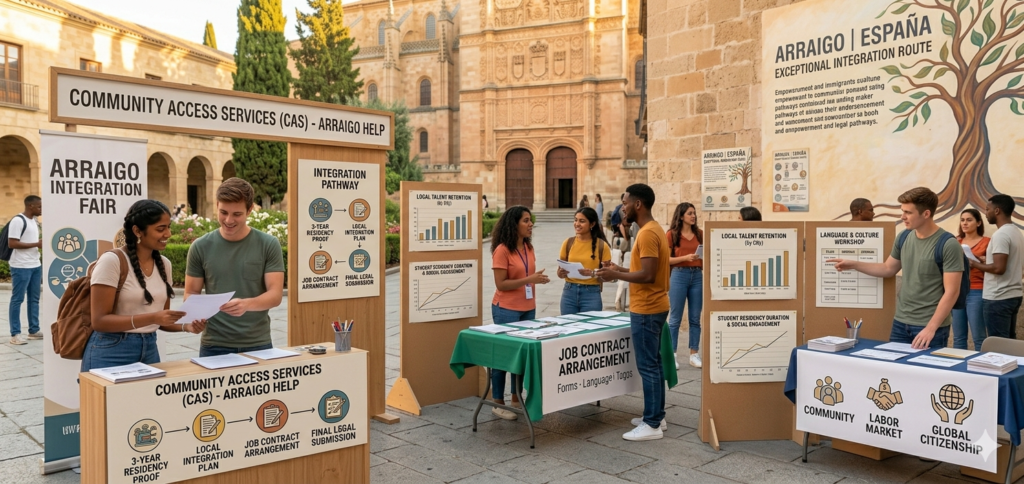
The Exceptional Circumstances Route, universally known in Spanish law as Arraigo (which translates to “roots” or “anchorage”), is a legal mechanism designed to regularize non-EU citizens who are currently living undocumented in Spain.
Rather than forcing someone to return to their home country to apply for a visa, Arraigo allows them to secure a legal residence and work permit from inside Spain based on their pre-existing ties to the country. Following major structural updates to the Spanish Immigration Regulations (Reglamento de Extranjería), the Arraigo framework has been significantly reorganized into highly specific, more accessible tracks.
The 5 Core Branches of Arraigo
Depending on how long you have lived in Spain and what your current situation looks like, you must apply under one of five specialized categories.
1. Arraigo Social (Social Roots)
Historically the most requested track, Arraigo Social allows individuals to regularize their status purely through local cultural and economic integration.
- Time Requirement: 2 years of continuous residence in Spain (reduced from the historical 3-year threshold).
- Key Requirement: A favorable Social Integration Report (Informe de Integración Social) issued by your local town hall or Autonomous Community. The interview evaluates your language skills (Spanish or regional languages like Catalan) and your community involvement.
- Employment: An employment contract is no longer strictly mandatory under this route; you can qualify if you have passive income or certified financial backing from an immediate family member who is a legal resident.
2. Arraigo Sociolaboral (Socio-Labor Roots)
This is the newly created branch explicitly tailored for undocumented individuals who have a concrete job offer.
- Time Requirement: 2 years of continuous residence.
- Key Requirement: A formal, valid employment contract signed with a solvent company or employer. The salary must meet or exceed the National Minimum Wage (SMI), and the contract must meet baseline weekly working hours.
- Advantage: Because integration is proved directly through the employment contract itself, you bypass the need to get a separate town hall social integration report.
3. Arraigo Socioformativo (Educational/Training Roots)
Designed to bridge Spain’s labor shortages by legalizing individuals willing to study or train for in-demand occupations.
- Time Requirement: 2 years of continuous residence.
- Key Requirement: A formal commitment to enroll in (or proof of ongoing enrollment in) a registered vocational training course (Formación Profesional), state certification course, or university program.
- Work Rights: This route grants a provisional residence card allowing you to work up to 20 hours a week while studying. Once you pass your course, you can modify this into a full-time work permit.
4. Arraigo Familiar (Family Roots)
This pathway is distinct because it carries no mandatory time requirement. You can apply immediately upon establishing the family link, and the resulting card grants comprehensive residence and work rights valid for 5 years. It is reserved for:
- Parents or legal guardians of a minor child who holds Spanish nationality.
- Adult children of an original Spanish citizen.
- Caregivers providing stable, documented support to a Spanish citizen with recognized dependency needs.
5. Arraigo de Segunda Oportunidad (Second-Chance Roots)
This branch replaces elements of the old Arraigo Laboral. It is a dedicated safety net for people who previously held a completely legal residence permit in Spain but accidentally lost it (e.g., failing a renewal deadline due to a job loss).
- Requirement: You must have a past history of contributing to the Spanish Social Security system for a minimum period (e.g., at least 6 months) before you fell into an irregular administrative situation.
The 2026 Emergency Windfall: Mass Regularization Window
In addition to the permanent Arraigo tracks above, Spain is currently running a historic, time-limited Extraordinary Regularization Process (approved via Royal Decree 316/2026).
If you are an undocumented individual or an unapproved asylum seeker currently in Spain, this temporary window bypasses the standard 2-year Arraigo waiting block entirely:
| Criteria | Requirements for the 2026 Mass Regularization |
| Arrival Deadline | You must prove you entered and were physically inside Spain before December 31, 2025. |
| Minimum Stay | You must demonstrate at least 5 months of continuous stay at the time of your application. |
| Strict Deadline | Applications must be filed online or in-person before June 30, 2026. No extensions will be granted. |
| The Prize | A bridge 1-year residence and work authorization, giving you a legal foundation to later transition smoothly into a standard Arraigo Social or Sociolaboral permit. |
Standard Verification Checklist
No matter which branch of Arraigo you file under, the immigration office (Oficina de Extranjería) requires an ironclad evidentiary file:
- Proof of Continuous Presence: You must prove you have not left Spain for more than 90 cumulative days during your required 2-year window. This is proven through a consecutive “paper trail”: historic municipal registrations (Empadronamiento), public health registry visits, dated bank card transactions inside Spain, or NGO assistance receipts.
- Clean Criminal Background Checks: You must provide a clean police record check from your country of origin covering the past 5 years. This document must bear the Hague Apostille stamp and be translated into Spanish by a certified Sworn Translator (Traductor Jurado).
- Valid Passport: Your physical passport must be valid and a full copy of every single page (including blank ones) must be uploaded.
The Electronic Application Pipeline
The fastest way to file an Arraigo claim is electronically through the centralized state platform (Plataforma Mercurio), typically handled via an immigration lawyer or an administrative manager (Gestor Autónomo) using a digital certificate.
1.Evidence Collection & Legalization: Step 1.
Gather your local proof of time spent in Spain (medical history, padrón). Concurrently, order your clean background checks from your home country, ensuring they are apostilled and sworn-translated.
2.Social/School Vetting (If Required): Step 2.
If filing via Arraigo Social, book your interview at the town hall to secure your positive Integration Report. If via Socioformativo, finalize your school registry or training course enrollment.
3.Digital Submission via Mercurio: Step 3.
Upload the complete file electronically to the Oficina de Extranjería. Processing timelines generally range from 45 to 90 days, during which you must remain inside Spanish territory.
4.TIE Issuance: Step 4.
Upon receiving your “Favorable Resolution,” pay the administrative state processing fee, book a fingerprinting appointment at your local police station, and pick up your physical plastic residency card (TIE) 30 days later.